Thursday, December 6, 2012

the well written - a.s. byatt

They took to silence. They touched each other without comment
and without progression. A hand on a hand, a clothed arm,
resting on an arm. An ankle overlapping an ankle, as they sat on
a beach, and not removed. One night they fell asleep, side by
side...He slept curled against her back, a dark comma against her
pale elegant phrase.

- A.S. Byatt, Possession

By Higinia Garay

on writing - more advice on first pages

Seven reasons why agents Esmond Harmsworth, Eve Bridburg, and
Janet Silver of the Zachary Shuster Harmsworth agency stopped
reading around the 250-word point:

1. Generic beginnings: Stories that opened with the date or the
weather didn’t really inspire interest. According to Harmsworth, you
are only allowed to start with the weather if you’re writing a book
about meteorologists. Otherwise, pick something more creative.

2. Slow beginnings: Some manuscripts started with too much
pedestrian detail (characters washing dishes, etc) or unnecessary
background information.

By Rose Brigid Ganly


Wednesday, December 5, 2012

on reading - cameron dokey

A story is alive, as you and I are. It is rounded by muscle and
sinew. Rushed with blood. Layered with skin, both rough and
smooth. At its core lies soft marrow of hard, white bone. A story
beats with the heart of every person who has ever strained ears
to listen. On the breath of the storyteller, it soars. Until its images
and deeds become so real you can see them in the air, shimmering
like oases on the horizon line. A story can fly like a bee, so
straight and swift you catch only the hum of its passing. Or move
so slowly it seems motionless, curled in upon itself like a snake in
the sun. It can vanish like smoke before the wind. Linger like
perfume in the nose. Change with every telling, yet always remain
the same.

- Cameron Dokey

By Erin McGuire


Tuesday, December 4, 2012

book covers - twenty theories on successful designs

For those of you curious about book cover design - whether it
be in regards to your future novel dreams or your current
self-published project, and so on - here's a great intro to what
can make a good book cover.

1. Face theory - 
Research suggests that human beings spend 48.6% of their lives
decoding facial communication, so a big draw for a potential
book buyer will be the familiarity of a face.


2. Association theory -
Human beings make a connection with a given stimulus that
leads to how they respond to something they see. The image on
the cover of Luca Turin's The Little Book of Perfumes uses the
familiar image of a perfume bottle to help the reader respond to
the idea that the book is about scent.


Monday, December 3, 2012

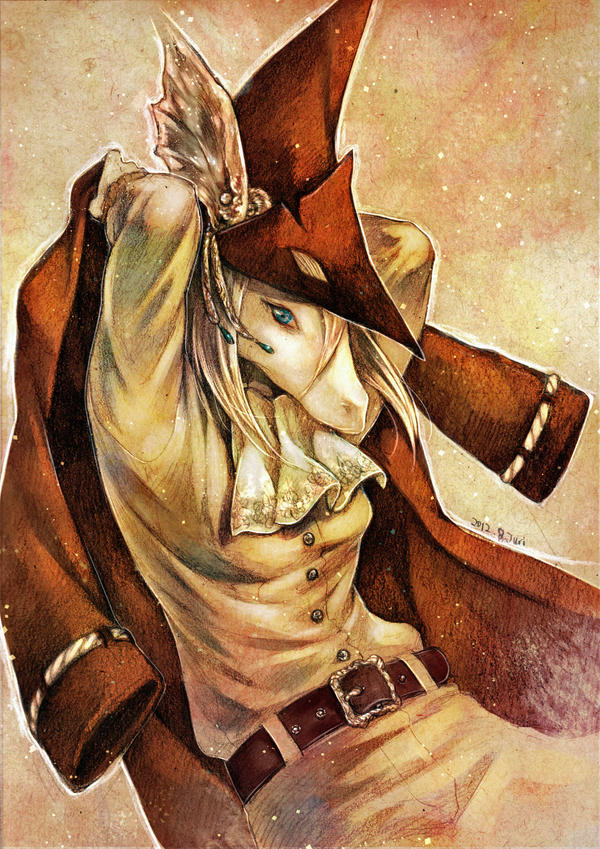
illustration - juri hayasaka chinchilla

Juri's illustrations are definitely on the side of traditional fantasy
- angelic heroins wandering the borders of light and shadow,
half-angels, half-goddesses, hair blowing in the wind, dresses
billowing against the breeze...  they're all quite beautiful and
capable of stirring one to want to write a woman up to the
standards of what Juri presents.

Side note: the first illustration is her self-portrait, which I find
rather fascinating in itself, a single frame in some great story.

Feeling at peace, however fragilely, made it easy to slip into the
visionary end of the dark-sight. The rose shadows said that they
loved the sun, but that they also loved the dark, where their roots
grew through the lightless mystery of the earth. The roses said:
You do not have to choose.
- Robin McKinley, Sunshine





the well written - neil gaiman & terry pratchett

The cafe door opened. A young man in dusty white leathers
entered, and the wind blew in empty crisp packets and newspapers
and ice cream wrappers in with him. They danced around his feet
like excited children, then fell exhausted to the floor.

- Neil Gaiman & Terry Pratchett, Good Omens

By Hillary Kleptach

Sunday, December 2, 2012

photo stories - richard burbridge

These mask photographs by Richard Burbridge in the latest issue
of Livraison Magazine illustrate how angles, proportions, and
textures can dramatically change the moods of an otherwise similar
set of faces.  One reads as heroic gladiator, another as fairy
warrior, a third - the last in the series - makes me think of a
sci-fi queen or Zeus' mistress.  The individuals who designed
these are storytellers in their own right.

A huge, monstrous thing, the mask sits on her head like the prow of
a broken, overturned ship, carved over with etched eyes and fins.
Yellow reeds and sea-stones hang from its tricorn-points. She is
looking at me, but all I can see is the wooden grotesque she wants
me to see instead of her face.

- Catherynne M. Valente, Silently and Very Fast